
Foundations for Mobility and
Battery Energy Storage
This chapter develops the vocabulary and reasoning needed to study battery pack design. It covers mobility and stationary Battery Energy Storage Systems with practical examples drawn from Indian operating conditions. Each topic is a standalone lesson.
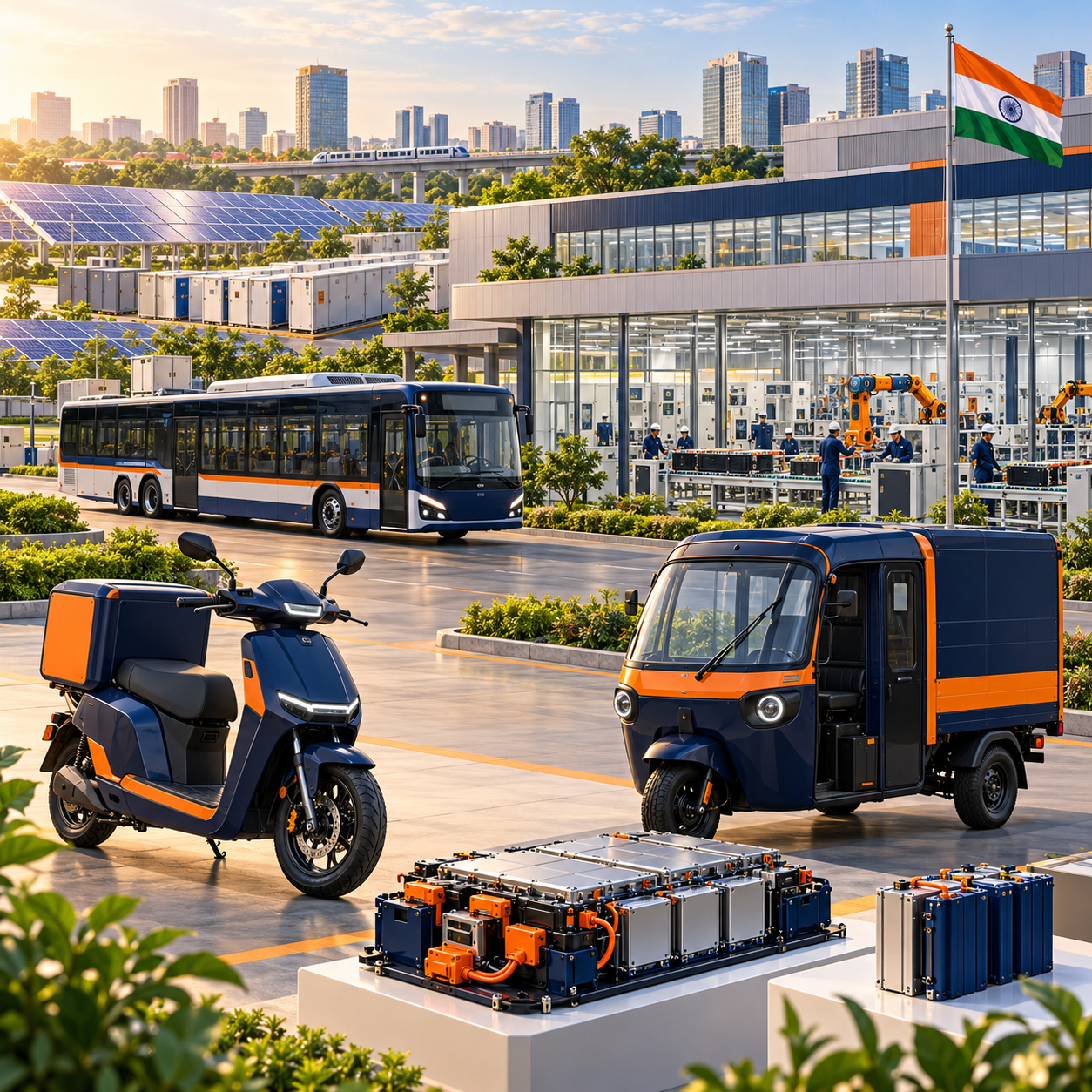
What this course helps you understand
A battery pack converts stored chemical energy into electrical energy that a vehicle or stationary system can use. Designing one means deciding how much energy it must store, how quickly it must deliver that energy, how it will be protected, and how its performance will change over time.
The course focuses on pack engineering — how commercial cells are selected and combined into a protected system. We also introduce cell chemistry because it explains voltage, charging behaviour, ageing and temperature limits.
Students connect classroom concepts with practical applications. Technicians understand why batteries need particular chargers and protection settings. Professionals in sales, procurement or fleet management learn to interpret specifications. Entrepreneurs understand what questions to ask before commissioning a battery product.
The language you will learn
Worked Example — Simple Mobility
This is a starting point only. Real design must also consider payload, gradients, traffic, temperature, battery ageing and reserve requirements.
Worked Example — Simple BESS
Increasing battery energy does not automatically increase inverter capability. Power and energy requirements must be checked separately.
Why is a 10 kW rating insufficient to specify a BESS? What additional information would you request from the factory customer? Explain why the scooter's calculated 3.0 kWh is an initial estimate rather than a guaranteed range specification.
How a rechargeable cell stores energy
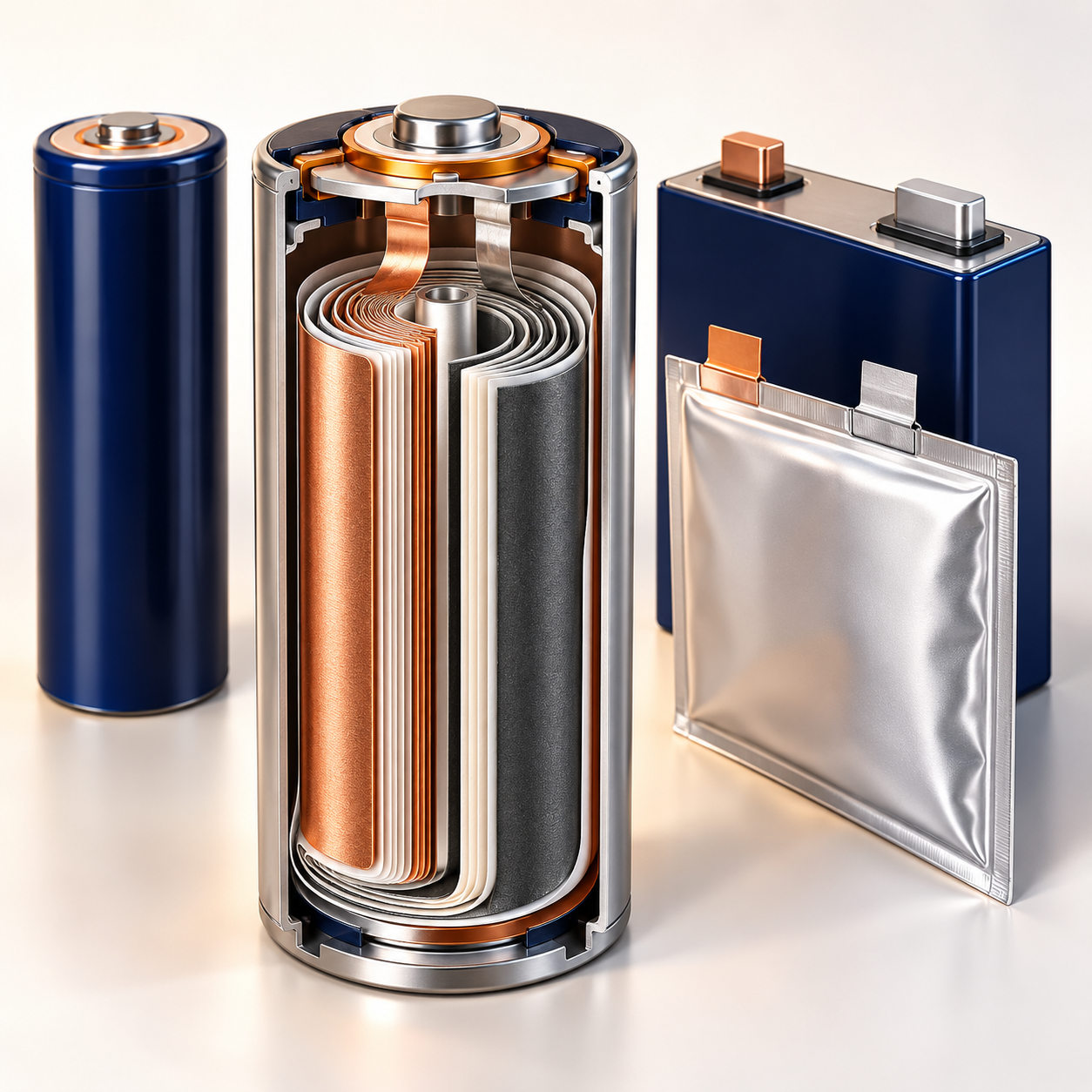
A lithium-ion cell stores energy through reversible electrochemical reactions. During charging, an external source drives the cell into a higher-energy state. During discharge, the cell supplies electrical energy to a connected load. Lithium ions move through the electrolyte inside the cell, while electrons travel through the external circuit.
The word rechargeable does not mean the process is perfectly reversible. Small side reactions and physical changes accumulate during use and storage, gradually reducing available capacity or increasing resistance.
The main parts of a lithium-ion cell
Lithium-ion is a family of chemistries
| Chemistry | Full Name | Key Advantage | Typical Use |
|---|---|---|---|
| LFP | Lithium Iron Phosphate | Cost, cycle life, thermal stability | Commercial EVs, BESS, 2W/3W |
| NMC | Lithium Nickel Manganese Cobalt Oxide | High energy density per kg | Passenger cars, performance EVs |
| NCA | Lithium Nickel Cobalt Aluminium Oxide | Very high energy density | Premium vehicles, aerospace |
| LTO | Lithium Titanate (negative electrode) | High power, very long life, fast charge | Buses, industrial, specialist |
A chemistry name is a useful introduction, but it does not fully describe a commercial cell. Actual suitability depends on the specific cell and its tested operating limits. No chemistry label guarantees a safe or economical pack.
Understanding voltage, capacity and energy
Actual energy is the integral of voltage × current over time. Using nominal voltage simplifies that relationship and is appropriate for introductory estimates only.
A cell is rated 3.2 V and 50 Ah. Its approximate nominal energy is 160 Wh. At 0.5C, the corresponding current is 25 A. Explain why these calculations do not prove that the cell can operate safely at 25 A in every environment. Your explanation should identify the separate current rating, temperature window, voltage range and relevant test conditions.
Begin with the job the battery must do
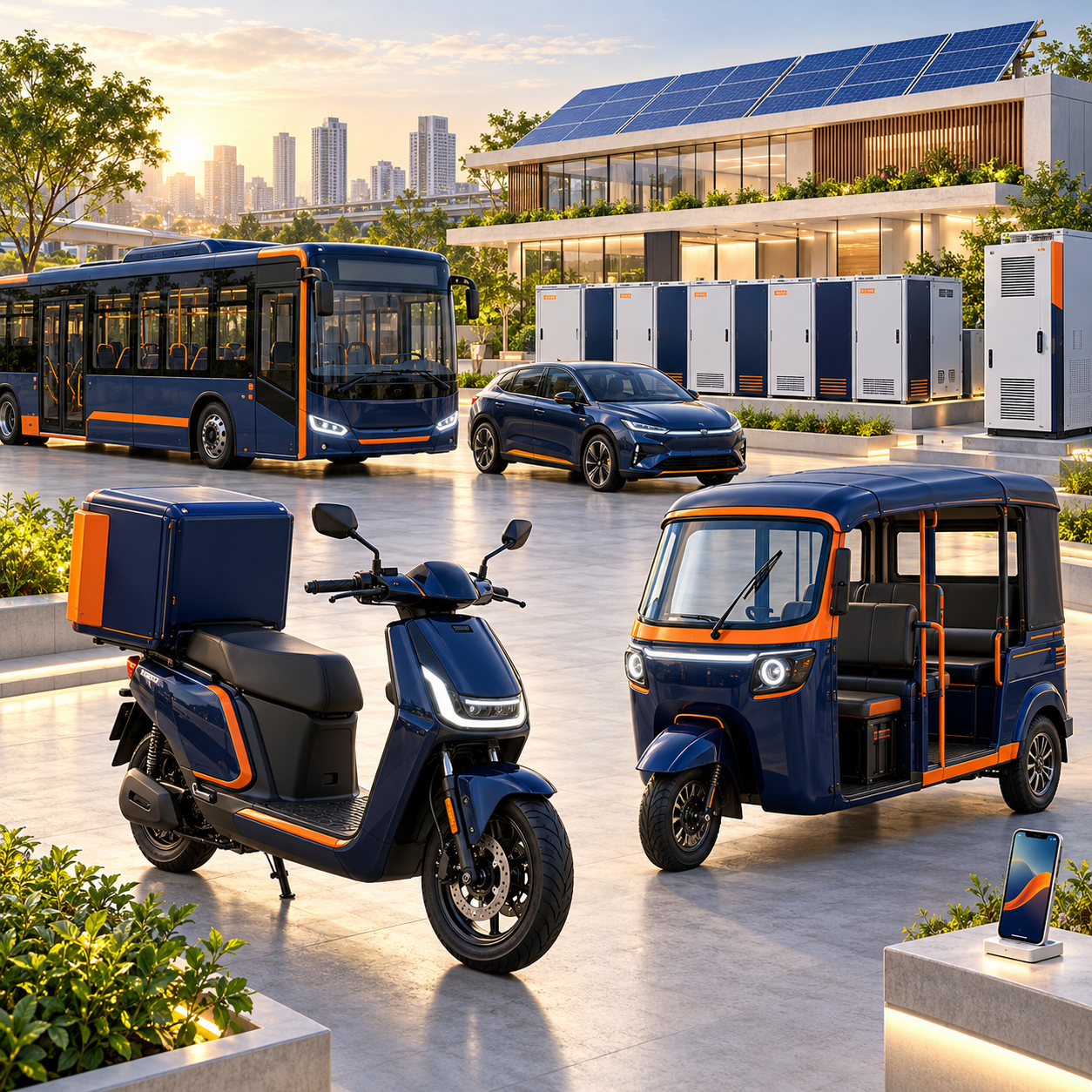
Lithium-ion batteries support portable electronics, mobility, industrial equipment and electricity storage. The same electrochemical principles apply across these uses, but a successful product depends on its operating duty — how the battery is charged, discharged, rested and exposed to its environment.
Before choosing cells, ask: what must the battery accomplish, and what conditions will it experience? A cell suitable for one product may be unsuitable for another because its power capability, lifetime, dimensions or protective requirements differ.
Electric Two-Wheelers
For electric scooters and motorcycles, battery design balances range, mass, space, cost and charging access. A removable pack also becomes an object people carry, insert and handle — weight, grips, locking arrangement and connector life matter alongside electrical specifications.
Indian conditions add exposure to heat, dust, road shocks and monsoon moisture. Protective design must account for the installation and foreseeable use rather than relying on a laboratory energy rating.
Electric Three-Wheelers and Small Commercial Vehicles
Operators value daily distance, vehicle availability and replacement cost because downtime affects earnings. Changing from lead-acid to lithium-ion alters mass, available energy, charging behaviour and system voltage — it cannot be treated as a simple substitution based on ampere-hours alone.
Battery Swapping
Swapping replaces a depleted removable battery with a charged one. The service depends on more than a removable enclosure. Batteries must be identified, charged correctly, checked for condition and tracked through repeated handling. Connector durability, alignment, authentication and compatibility become central design requirements.
Residential and Commercial BESS
Compare a private scooter, a delivery scooter and a 100 kW factory BESS. Which needs are shared, and which are different? Explain why a four-hour BESS is not automatically better than a two-hour system. Relate the choice to the intended service, delivered energy and available charging window.

Understanding the battery value chain
The global position in 2026
The IEA's Global EV Outlook 2026 reports approximately 1.2 TWh of EV battery deployment in 2025 and more than 4 TWh of global nameplate manufacturing capacity at the end of that year. China accounts for over 80 percent of global manufacturing capacity. These figures describe different measures.
Cost comparisons need a defined boundary. Cell price per kWh excludes many pack components. Pack price excludes some integration costs. An installed BESS quotation may include or exclude power conversion, civil work and grid connection. Ask what is included before interpreting a price as cheap or expensive.
This illustration excludes financing, maintenance and downtime. It shows why the lowest upfront price may not mean the lowest cost of service.
What is the difference between a 5 GWh factory announcement and 5 GWh of batteries delivered to customers? Why should a pack price and an installed BESS price not be compared directly? Describe one Indian opportunity that does not require establishing a cell factory.
The early development
Research in the 1970s explored rechargeable lithium batteries. Stanley Whittingham contributed an early intercalation cathode approach. John Goodenough demonstrated a higher-voltage cathode. Akira Yoshino developed a commercially viable configuration using a carbon-based negative electrode. Commercial introduction came in 1991, recognised through the 2019 Nobel Prize in Chemistry.
The commercial position in 2026
LFP has gained importance where cost and durability matter. The IEA reports that LFP represented over 55% of globally deployed EV battery capacity in 2025. Pack architecture has also changed — cell-to-pack arrangements reduce or remove conventional modules, improving space utilisation but requiring careful engineering for repair and thermal propagation.
Solid-state batteries replace liquid electrolyte with solid materials, pursuing potential advantages in energy density and safety. However, interfaces, manufacturing, durability, pressure requirements and commercial cost remain important open questions. The IEA's 2026 assessment notes progress but states that promised advantages still require demonstration in real-world applications at scale. Solid-state is a technology family with several approaches, not a single finished product.
Sodium-ion batteries use sodium rather than lithium as the principal mobile ion — they are not a type of lithium-ion battery. They may serve some cost-sensitive applications if their performance and supply economics suit the duty. Material abundance alone does not determine finished-cell price or market success.
Reading the future without exaggeration
1. What has been measured? 2. Under what conditions? 3. At what production scale? 4. What remains unresolved?
A stated target for 2030 is useful information, but it is still a target. A company announcement should be separated from independently tested results.
Explain the difference between a laboratory breakthrough and a commercial battery. Why can a chemistry with lower energy density still be attractive for BESS? If a company promises a new battery in 2030, list the evidence you would request before using that promise as the basis for a product available today.
Cell formats
Series connections (S) — increase voltage
Parallel connections (P) — increase capacity
Real parallel groups require control of current sharing, cell matching and fault paths. These formulas are not assembly procedures — use diagrams and calculations only.
What the pack adds beyond cells
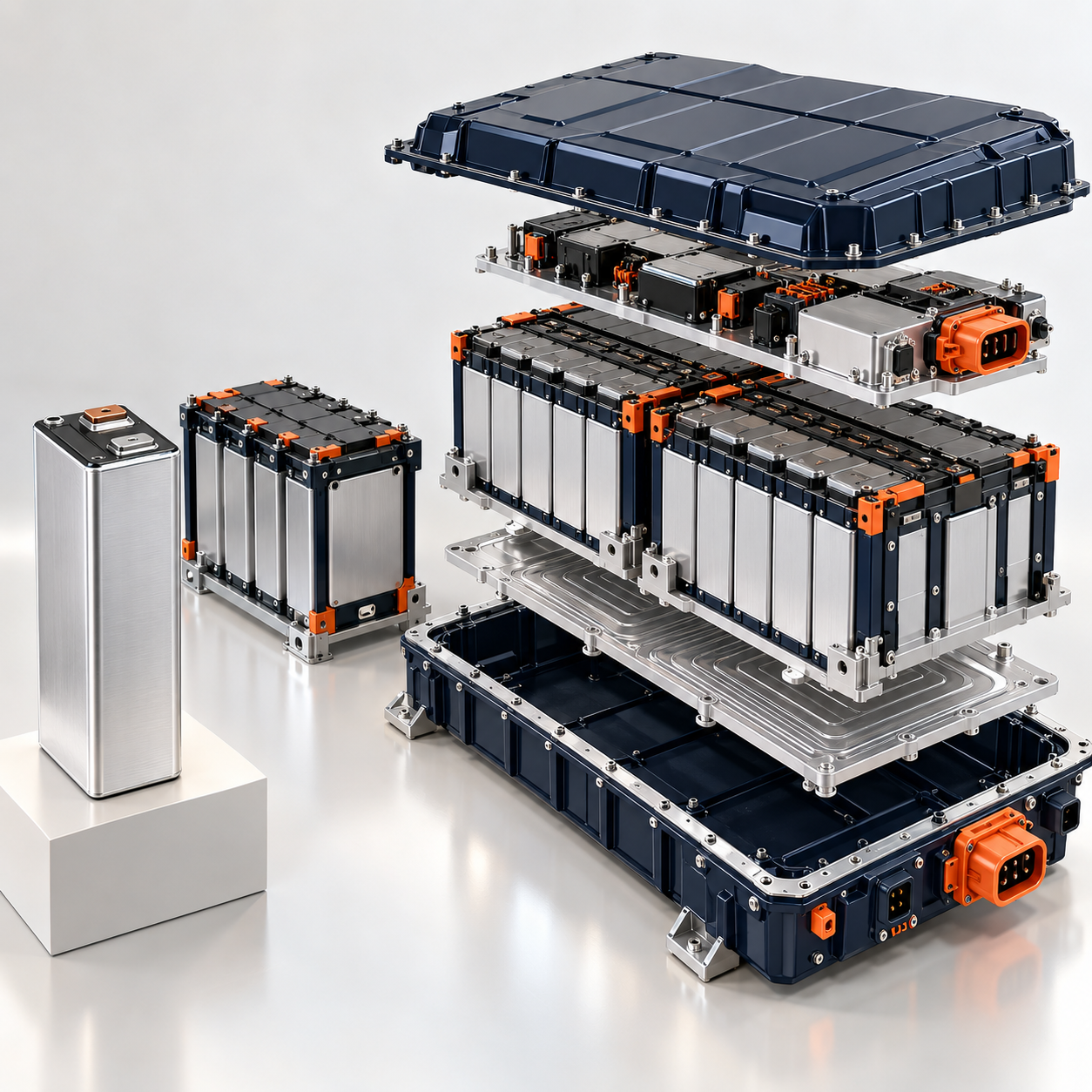
A pack adds busbars or conductors (resistance → heating), insulation (prevents unintended contact), enclosure (protection and interfaces), protection devices (fuses, contactors, sensing) and thermal management. Every additional component contributes mass, volume and cost — but may be essential to dependable operation.
A teaching pack containing 10 kWh of nominal cell energy and weighing 80 kg has nominal specific energy of 125 Wh/kg. It cannot be described using the cell supplier's higher figure without identifying the different boundary. Cell values exclude the hardware required in a pack.
Calculate the nominal voltage, capacity, energy and total cell count of a 16S3P arrangement using 3.2 V, 100 Ah teaching cells. Answers: 51.2 V, 300 Ah, 15.36 kWh, 48 cells. Explain why those answers do not establish the pack's safe current rating, environmental resistance or usable lifetime energy.
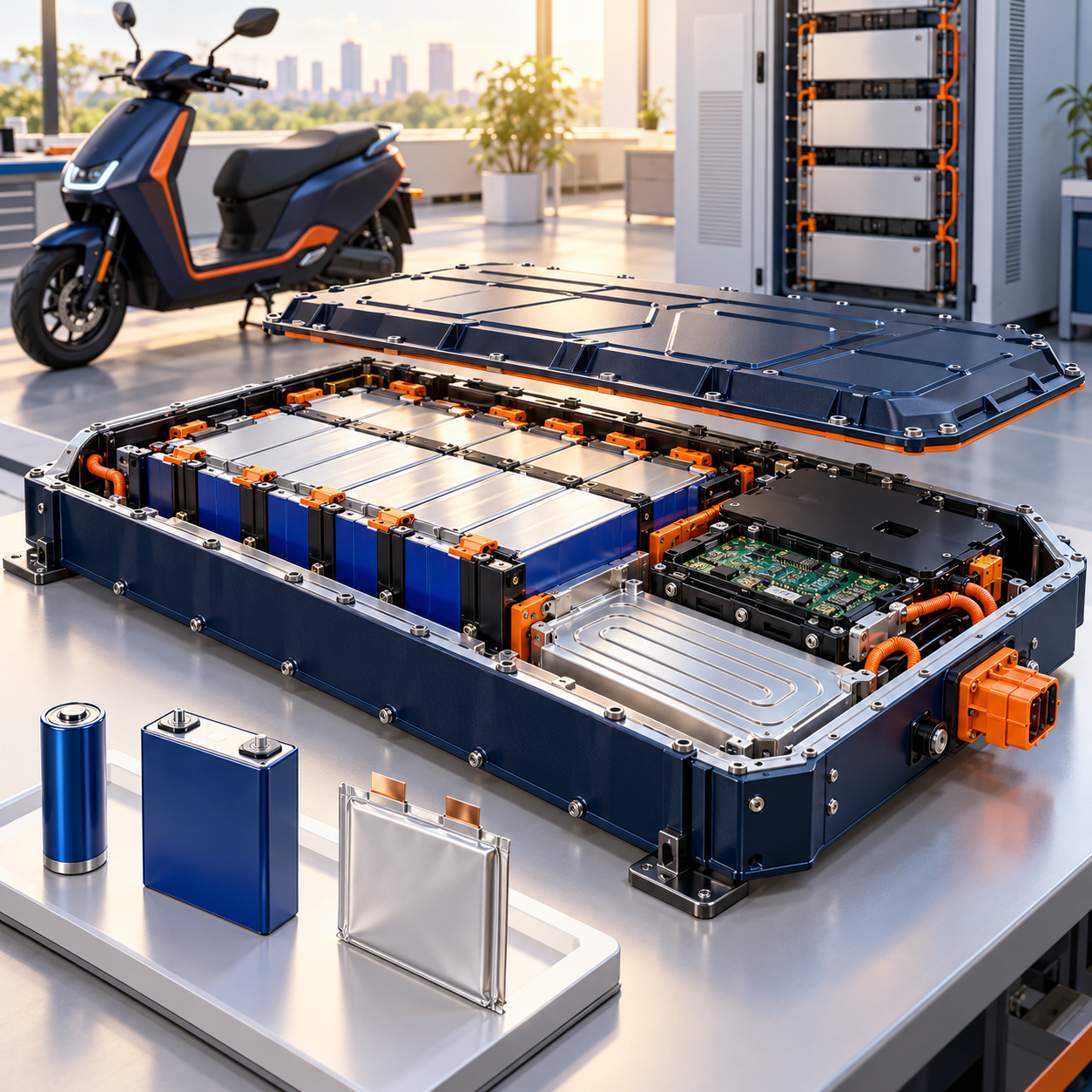
Start with a requirement sheet
Before selecting a cell, record the required energy, continuous and peak power, voltage range, charging time, space, mass, environmental conditions and service life. Include how the product will be maintained and what happens if it becomes unavailable.
A customer asking for a "500 kW battery" has supplied only a power requirement. The engineer still needs: energy and duration → load profile → site electrical characteristics → operating schedule → output boundary for performance measurement.
Establish the energy budget
Document each allowance so they are not counted twice. If a supplier already guarantees delivered energy at end of life, adding the same allowances again overstates the requirement.
Check power and current at minimum voltage
The five engineering pillars of pack design
Why must current be assessed at minimum operating voltage? What assumptions produced the 340 kWh storage estimate? Explain why adding more cells cannot compensate for an incompatible inverter, ineffective cooling or poor connections.
India's mobility demand
A government backgrounder published in August 2026 reports approximately 2.3 million EV sales in 2025, compared with around 50,000 in 2016. Two- and three-wheelers are major contributors. Equal vehicle counts do not mean equal battery energy demand — segment mix matters.
India's stationary storage requirement
The Ministry of Power's July 2026 statement cites the National Electricity Plan's projected BESS requirement of 8.68 GW and 34 GWh for 2026–27, rising to 47.24 GW and 236 GWh for 2031–32. These are planning requirements, not reported installed capacity.
As of 30 June 2026, 15,754 MW and 42,530 MWh of BESS were under construction in India. Separately, an additional 30 GWh BESS programme has ₹5,400 crore of funding approved.
Entry points include technical sales, application engineering, testing, embedded software, thermal design, procurement and quality. Growth in commercial vehicles, buses and BESS creates demand for thermal engineers, electrical designers, embedded-software teams and testing services — roles that do not require establishing a cell factory.
Installed renewable capacity and renewable electricity generation are different measures. A battery does not make its charging electricity automatically renewable. Policy support, tender, award, construction, commissioning and operating performance are separate milestones — keep the sequence clear when reading government announcements.
Why does EV sales growth not translate directly into the same growth in lithium-ion GWh demand? Distinguish a 2031–32 storage requirement from a commissioned installation. Name two ways an Indian battery business can create value beyond importing cells and assembling them, and explain the skills each would require.
References support identified factual passages. Worked examples and numerical assumptions are original teaching illustrations. For commercial work, verify current official texts, selected cell datasheets and application-specific requirements.